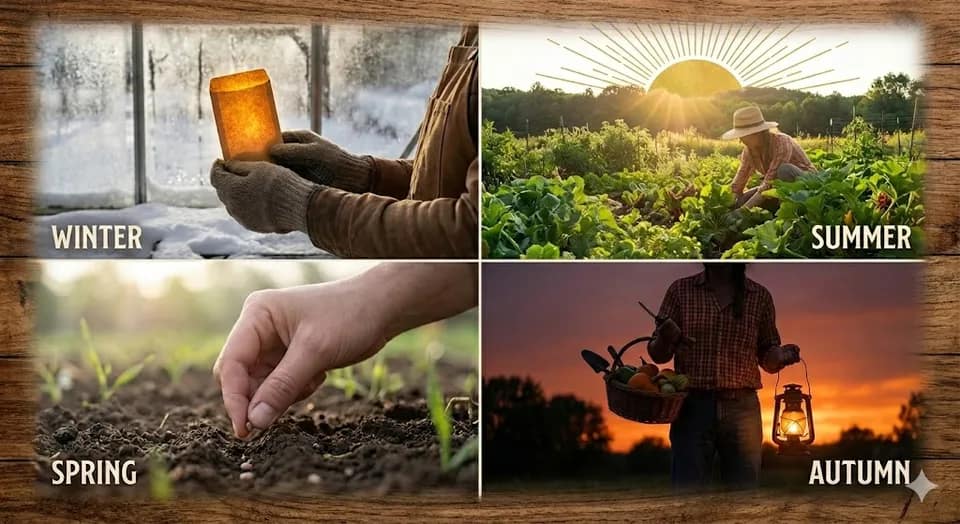
a slow-turning warmth nestling like fresh‑washed linen.
Spring waits in the marrow,
feeling me needing— quiet as a thaw,
seeds listen for heedings.
Summer’s oath is kept in the distance,
humming behind the horizon’s teeth.
The circling sun dances,
choosing me every season,
teaching me to rise when it rises,
to bow when it falls,
to carry its fire
even when the world goes dim.
The Itch in the Marrow
Every year, the sun starts to flirt with the dry bulb. I watch the mercury climb—not steadily, but in fits and starts, a tease of warmth that pulls at something deep in the marrow. This is the drive.
It’s not rational. The frost date is still weeks out. The soil is cold. The catalogues have barely arrived. But the light has changed, stretched just enough to whisper that spring is coming, and that whisper becomes an itch, then a burn, then a compulsion I can’t ignore.
I align with the mercury. When the thermometer hits that sweet spot—when the air temperature starts brushing against the numbers I’ve memorized from years of planting too early, planting too late, planting just right—the drive kicks in. It’s time to start the work.
This is the farmer’s curse and blessing: to be so attuned to the sun’s dance that you feel it in your bones before you see it in the soil. To know, without checking, when the season is about to turn. To be chosen by the circling sun, season after season, and to answer the call even when your hands are still cold from winter.
Do you feel the drive? What pulls you to the garden before the season is ready? Drop a comment below—I’d love to hear when the itch hits you, and how you know it’s time to start. And if this resonates, hit that like button so I know to write more
I was loved in the womb, then borne out. As a child I learned of love laid in a tomb, then rising out. In my teens I chased a love I couldn’t name, wandering to and fro, taking every crooked route.
At a crossroads I was caught—yet I didn’t want out. My prison turned prism, scattering doubt. Through its colors we walked, and love grew out. Fruits came tenderly, prospered, and withered out.
Still, we don’t question the Author— it all works out.
Now I ponder the garden: seeds go to ground, the ground bears out. I prune the leaves, and the stems fruit out. In the hush of morning light, I kneel and sort things out — the tender shoots that reach, the stubborn ones that twist about.
The soil keeps its secrets, yet it never shuts me out. It takes what falls, breaks it down, and sends new mercy out. What I bury in its darkness, it returns without a doubt — a lesson whispered softly: nothing stays the way it starts out.
So I tend what’s given, let the seasons round things out. I cut away the withered so the living can rise out. And in each small harvest, I feel the old truth shout: the same hand that formed my story forms these furrows out.
While these are the stories I find in the soil, the soil itself has its own technical challenges this season. If you’re navigating your own ‘crooked routes’ in the garden, you might find my series on Gardening in the Humid Cold helpful—it’s where I’m learning to blend old-timer wisdom with a shifting climate.
I live near most of the major big box stores—Home Depot, Lowe’s, Tractor Supply, Walmart. The others are within striking distance, maybe a planned trip away. On paper, I’m living in a paradise of retail access. In practice, I’m living in a desert of plenty.
“To be a consumer in the total economy, one must agree to be totally ignorant, totally passive, and totally dependent on distant supplies and self-interested suppliers… Though one is shopping amid an astonishing variety of products, one is denied certain significant choices.” — Wendell Berry, The Idea of a Local Economy (2001)
When every store has everything (except what you came for)
There is a specific irony to walking into a “big box” store that claims to be a one-stop-shop for home, garden, and life. You can buy a 12-pack of industrial-sized mayonnaise, a smart fridge that tweets, and a 50-piece socket set, but the moment you need a specific, functional tool for a foundational task—like checking if your soil is actually ready for seeds—the “everything store” suddenly feels very small. You’re surrounded by thousands of SKUs of plastic lawn flamingos and generic potting soil, yet the one instrument that bridges the gap between “guessing” and “growing” is nowhere to be found.
You can rarely find anyone in the store to talk to. When you do find someone, you often have to coax them into working in another department. Let me explain: Say I go to Home Depot and someone sees me wandering around—they may be from appliances. They might not be able to help with my plumbing fitting questions. This is on the rare occasion that you find anyone in the store except people watching self-checkout.
The parking lot consultation: a modern rural ritual
When the search fails, the ritual begins. You trudge back to your truck, and inevitably, you run into someone else doing the same thing. You lean against the tailgate for fifteen minutes, exchanging the “did they have it?” headshake. This is the modern rural consultation: a localized brain-trust where you trade tips on which obscure hardware store three towns over might have a soil thermometer in a dusty bin in the back. It’s a community bound together by the shared experience of being let down by a supply chain that prioritizes volume over utility.
Jane Jacobs understood what we’ve lost:
“The trust of a city street is formed over time from many, many little public sidewalk contacts… getting advice from the grocer and giving advice to the newsstand man… The sum of such casual, public contact at a local level… is a feeling for the public identity of people.” — The Death and Life of Great American Cities
The parking lot consultation is what’s left when the grocer becomes a faceless corporation and the newsstand man becomes a self-checkout kiosk. We’re trying to recreate that local knowledge network in the gaps between the big boxes.
Why a soil thermometer is too specialized for the everything store
The “everything store” loves a 3-in-1 gadget that “measures” moisture, pH, and light (often poorly), but a dedicated, high-quality stainless steel soil thermometer is apparently “too specialized.” To a big-box buyer, a thermometer is for a turkey or a forehead. They don’t account for the gardener who knows that planting tomatoes in 50°F soil is just an expensive way to watch plants die. Tools like the Taylor Soil Temperature Thermometer or a heavy-duty compost probe aren’t “niche”—they’re essential—but they don’t fit into the high-turnover, “good enough” philosophy of the modern retail giant.
The internet tax: shipping costs and waiting days for what should be on a shelf
So, you give up and pull out your phone. You find the AcuRite Soil Thermometer or a digital version from Harris Seeds. Now you have to pay the “Internet Tax.” It’s not just the shipping cost that stings; it’s the “waiting tax.” You have a window of perfect weather now. Your seeds are ready now. But because a basic metal probe isn’t stocked locally, you’re forced to wait three to five business days for a package to arrive, effectively stalling your season because of a “missing link” in a logistics chain.
Wendell Berry said it plainly:
“Global thinking can only be statistical. Its shallowness is exposed by the least intention to do something. Unless one is willing to be destructive on a very large scale, one cannot do something except locally, in a small place.” — The Idea of a Local Economy (2001)
Gardening is the ultimate local action. You can’t garden statistically. You can’t plant seeds on a three-to-five-business-day delay. The soil is ready when it’s ready, and the big box model has optimized itself right out of being able to serve that reality.
What big box optimization leaves behind
This is the “optimization” trap. When retailers use algorithms to decide what stays on the shelf, they optimize for the “average” person, and in doing so, they leave the actual practitioner behind. They trade expertise for efficiency and reliability for “reach.” What’s left behind is the soul of the project. We lose the ability to walk into a store, speak to someone who understands the local climate, and walk out with the exact tool needed to succeed—whether that’s a soil thermometer or a soil blocker that eliminates plastic waste while growing better plants.
The modern big box has mastered the art of presence without service. They’ve built these massive footprints—acres of parking, football fields of shelving—but they’ve hollowed out the human infrastructure that made hardware stores useful in the first place. You’re surrounded by product but starved for knowledge. You’re drowning in inventory but can’t find a single person who knows whether your local frost date matters for pea seeds.
We’re left with a world of “everything” that feels increasingly empty when you actually have work to do. The paradox is complete: I live within minutes of every major retailer in America, and yet I still have to wait for the mail to arrive before I can plant my garden.
The Big Box Paradox Shopping Guide: 5 to Buy, 5 to Skip
CATEGORY
✅ THE WINNERS
❌ THE LOSERS
THE VERDICT
Bulk Materials
Compost & Mulch. Cheap volume for filling space.
Specialty Bags. Kelp or Myco. It’s likely dead.
Buy Bulk: Generic is fine. Skip “Life”: Buy biology from BioAg.
Hand Tools
Moving Dirt. Shovels and rakes you can abuse.
Cutting Edge. Cheap pruners that dull fast.
Buy Steel: If it’s a lever. Skip Blades: Get Felco elsewhere
Hardware
Infrastructure. Lumber, PVC, and fencing.
Precision Water. Drip kits that leak/clog.
Buy Heavy: Wood and wire. Skip Tech: Use DripWorks for irrigation.
Seeds & Plants
Clearance Only. 75% off “rescue” plants.
Full Price. Weak transplants and old seeds.
Buy Cheap: Only if it’s a $1 gamble. Skip Foundation:Johnny’s grows better
The “Paradox”
Absolutely Nothing.
Soil Thermometers. The tools you actually need.
The Internet Tax: Pay it. Precision beats convenience every time
💡 THE PARKING LOT ALTERNATIVE
When the big box fails you, try:
Local hardware stores (that odd tool in the back bin)
Feed & farm supply stores (bulk amendments, real tools)
Online specialty retailers (accept the internet tax for precision)
The parking lot network (ask other frustrated gardeners where they source their gear)
🧠 REMEMBER
“The ‘everything store’ loves a 3-in-1 gadget that measures moisture, pH, and light (often poorly), but a dedicated, high-quality tool is apparently ‘too specialized.’”
Big box stores optimize for volume, not expertise.
Shop there for bulk and basics. Shop elsewhere for precision and knowledge.
💾 Save this guide → Print it, keep it in your truck, reference it before you walk into the desert of plenty.
More from Farmer’s Rant
If this piece resonated with you, you might also enjoy The Drive—a meditation on what pulls us to the garden before the season is ready, and how we align with the mercury instead of the calendar.


Leave a Reply